
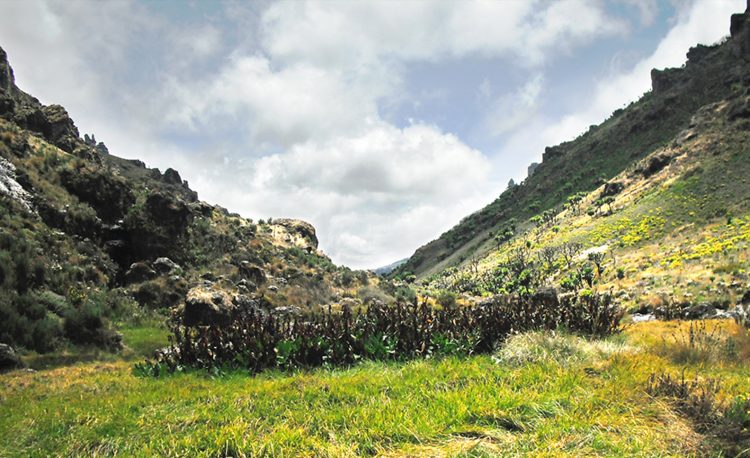
The 1145 km² Mount Elgon National Park protects the higher slopes of the 4321m Mount Elgon, an extinct volcano on the Uganda-Kenya border.
Mount Elgon is one of East Africa’s oldest physical features, first erupting around 20 million years ago. The trek to the summit passes through the distinctive altitudinal vegetation zones restricted to Eastern Africa’s highest mountains.
Mount Elgon’s cool slopes with its distinctive, waterfall streaked cliffs are an ideal retreat, especially during the long drive through dusty Karamoja to/from Kidepo Valley National Park.
The 1,145 km² Mount Elgon National Park is located on the 4321m-high Mount Elgon in eastern Uganda. The border with Kenya bisects the mountain and national parks in both countries protect the flora and fauna on the higher contours. This trans-boundary conservation area has been declared a UNESCO Man & Biosphere Reserve.
Wild life
The 1,145 km² Mount Elgon National Park is located on the 4321m-high Mount Elgon in eastern Uganda. The border with Kenya bisects the mountain and national parks in both countries protect the flora and fauna on the higher contours. This trans-boundary conservation area has been declared a UNESCO Man & Biosphere Reserve.
Local people
Mt. Elgon is home to two tribes, the Bagisu and the Sabiny. The Bagisu, who live on the southern and western slopes of Mount Elgon are known for their colourful, biannual Imbalu ceremony in which boys are initiated into manhood through circumcision. The Bagisu, also known as the Bamasaba, consider Mount Elgon to be the embodiment of their founding father Masaba and refer to the mountain by this name.
Access
By road
Mount Elgon National Park lies above Mbale town, 235km east of Kampala. The route beyond Mbale is surfaced as far as Kapchorwa town on the northwest flank of the mountain. Dirt roads lead off this road to the various trailheads.
Mount Elgon can also be reached from Kidepo Valley National Park in northeast Uganda. The 420km drive is possible in one long day but an overnight stop in Morotoor Pian Upe Wildlife Reserve is recommended.
When to visit
Mount Elgon can be climbed all year round though the dry seasons between June-August and December-March are most enjoyable.
Accommodation
Comfortable budget and mid-range resorts are found in Sipi town, 13km from Kapkwai while Mbale town offers a wide choice of hotels.
Activities and attractions
-Kapkwai Tourist Exploration Center
The UWA-run Forest Exploration Center lies on the park edge, 13km beyond Sipi. It doubles as an education centre for local schools and researchers as well as a trailhead for the Sipi route to the peaks.
-Mountain climbing
Several routes ascend to the 4321m Wagagai peak, the summit of Mount Elgon.
The Sasa Trail ascends from the small town of Budadiri (1250m a.s.l.) in the Sironko Valley. The shortest and most direct option, it is possible to reach the summit and descend to Budadiri in 3 or (more comfortably) 4 days. It does however involve a stiff altitudinal gain of 1650m, including an ascent of the Mudangi Cliffs, on Day One.
The Sipi Trail involves a longer but gentler ascent, starting 800 higher than Budadiri at the FEC (2050m). Other options are the Piswa and Suam routes on the northern side of the mountain and a proposed new route at Bushiyi.
-Forest walks
Routes over varying length explore the forest around the FEC passing caves, waterfalls and viewpoints and providing the opportunity to observe birds and primates.
-Nkokonjeru and WanaleRridge
As the map shows, a narrow corridor of parkland extends 25km west from the Mount Elgon massif towards Mbale town. This follows the Nkokenjeru Ridge, a 25 km-long tongue of lava that burst out of the side of the volcano after the cone had collapsed to block the main vent. A trail within this section of the park visits the Khaukha Cave. The ridge ends at the lofty Wanale Cliffs (outside the park) which tower 700m above Mbale. A road winding upwards from the town through a gap in the cliffs leads to some stunning viewpoints and sites with paragliding potential.
OUTSIDE THE PARK
-Sipi falls
The 7km section of the Sipi Valley immediately outside the national park is improbably scenic as the river plunges over three sets of basalt cliffs during its descent to the plains beneath. These have given rise to a cluster of tourist lodges and many activities.
-Mountain biking
The 7km section of the Sipi Valley immediately outside the national park is improbably scenic as the river plunges over three sets of basalt cliffs during its descent to the plains beneath. These have given rise to a cluster of tourist lodges and a variety of activities.
-Rock climbing
Many of the basalt cliffs around Sipi have been bolted and can safely be climbed. Contact Sipi River Lodge or the Mountain Club of Uganda for details
-Coffee tour
Uganda’s finest coffee is produced from Arabica beans grown on Mount Elgon. Take a guided tour of a coffee garden at Sipi to see how the beans are grown and ground. Other regional attractions include the Pian Upe Wildlife Reserve and Nyero Rock paintings near Kumi.